This Aeronautical Information Circular (AIC) aims to disclose the temporary changes to Brazilian airspace during the 30th United Nations Climate Change Conference (COP30), to be held in Belem-PA, as well as the general and specific procedures to be followed by pilots in command and Air Traffic Control (ATC) units of the Brazilian Airspace Control System (SISCEAB) during the event.
This publication applies to all those who, when performing their duties, will use Brazilian airspace during the 30th United Nations Climate Change Conference (COP30).
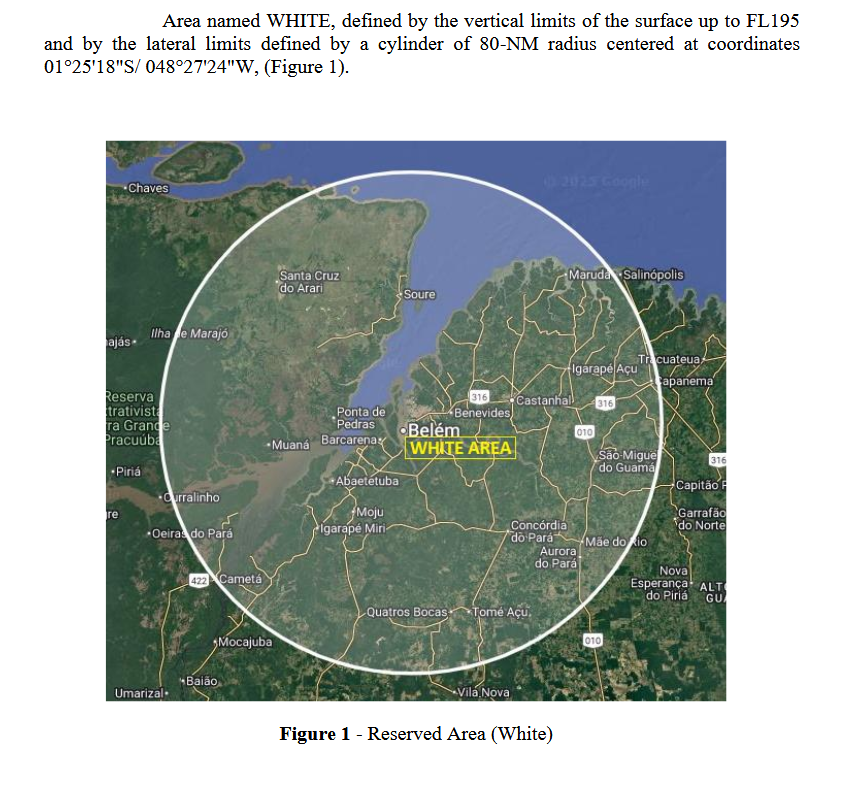
ATTACHMENT A – EXCLUSION ZONES – RESERVED AREA;
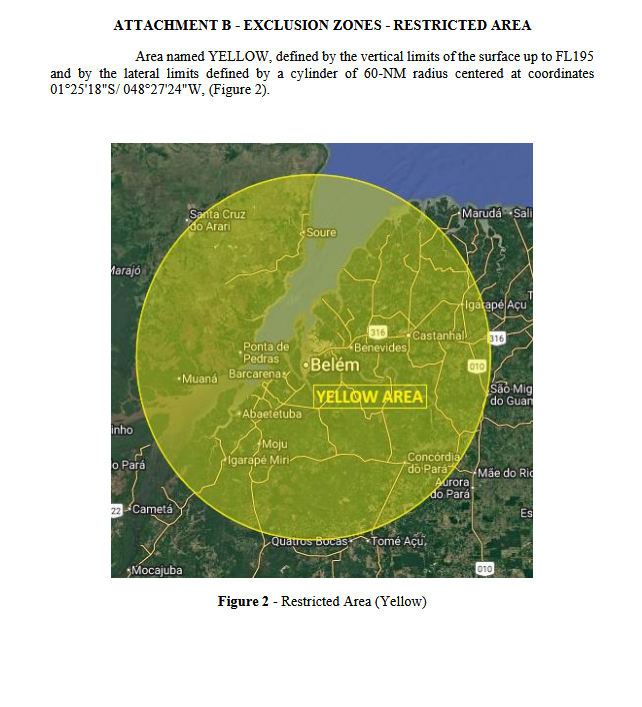
ATTACHMENT B – EXCLUSION ZONES – RESTRICTED AREA;
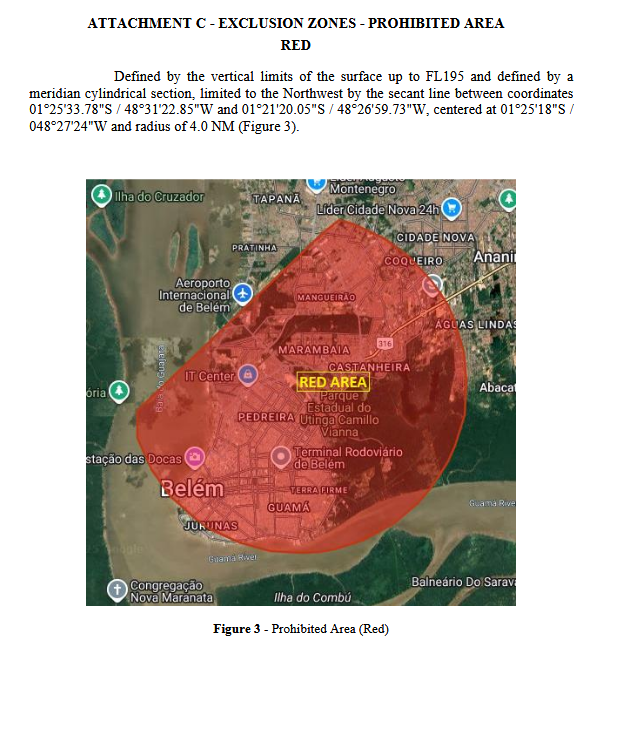
ATTACHMENT C – EXCLUSION ZONES – PROHIBITED AREAS – RED (PARQUE DA CIDADE);
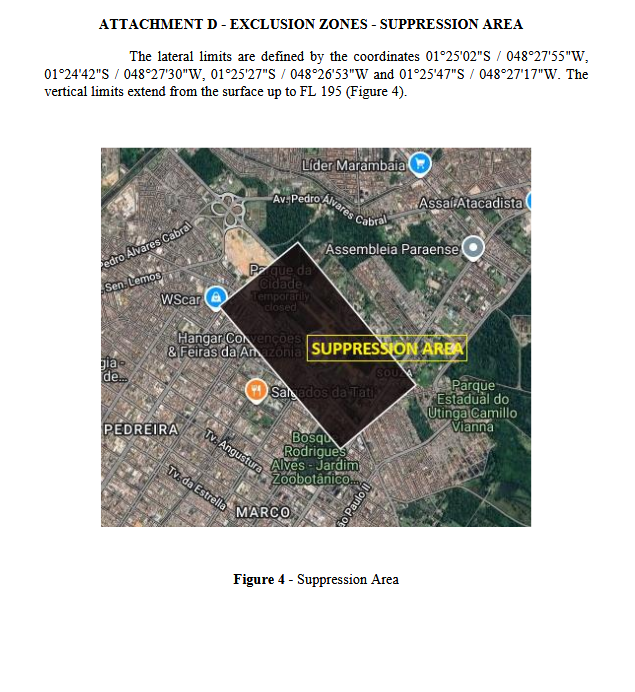
ATTACHMENT D – EXCLUSION ZONES – SUPPRESSION AREA;
ATTACHMENT E – EXCLUSION ZONES – AREVO-BE;
ATTACHMENT F – EXCLUSION ZONES – ACAV-BE;
ATTACHMENT G – EXCLUSION ZONES – HOURS OF ACTIVATION;
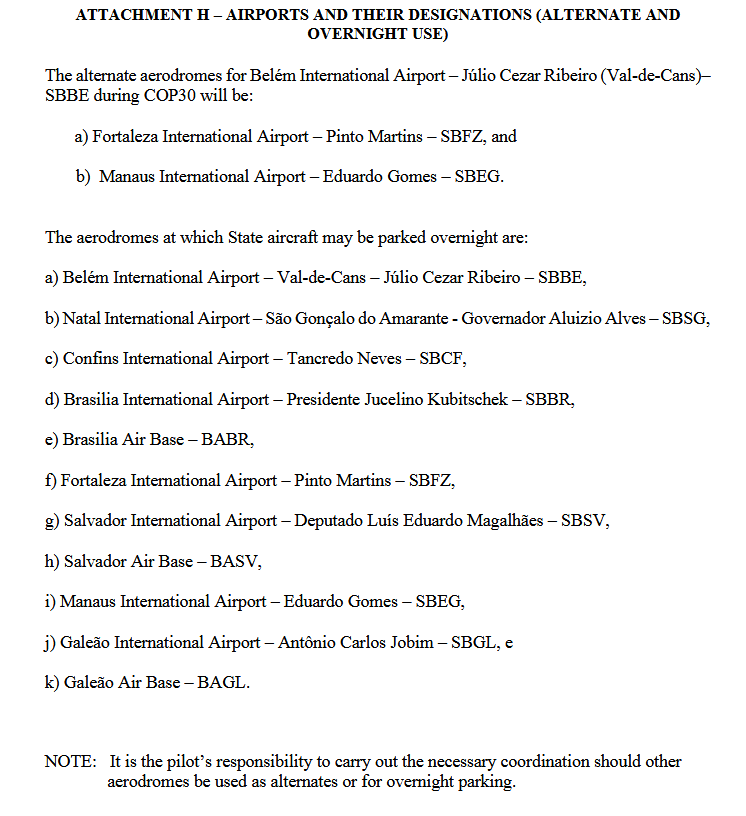
ATTACHMENT H – AIRPORTS AND THEIR DESIGNATIONS (ALTERNATE AND OVERNIGHT USE); and
ATTACHMENT I – CONTACTS FOR CONTRACTING GROUND HANDLING, CATERING, PARKING AND SUPPLY SERVICES.
ATTACHMENT B – EXCLUSION ZONES – RESTRICTED AREA;
ATTACHMENT C – EXCLUSION ZONES – PROHIBITED AREAS – RED (PARQUE DA CIDADE);
ATTACHMENT D – EXCLUSION ZONES – SUPPRESSION AREA;
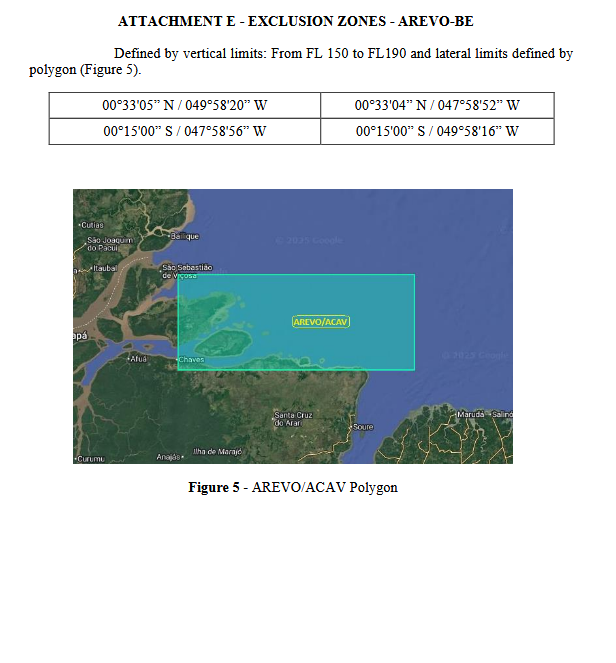
ATTACHMENT E – EXCLUSION ZONES – AREVO-BE;
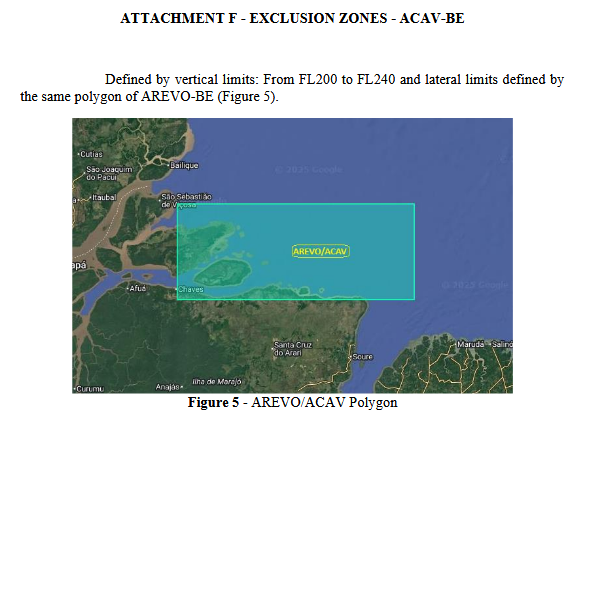
ATTACHMENT F – EXCLUSION ZONES – ACAV-BE;
ATTACHMENT G – EXCLUSION ZONES – HOURS OF ACTIVATION;
ATTACHMENT H – AIRPORTS AND THEIR DESIGNATIONS (ALTERNATE AND OVERNIGHT USE); and
ATTACHMENT I – CONTACTS FOR CONTRACTING GROUND HANDLING, CATERING, PARKING AND SUPPLY SERVICES.
1.4.1. The growth of air movements, expected during the COP30, reinforces the need for prompt service and efficiency in the provision of Air Traffic Services (ATS) and Air Traffic Flow Management (ATFM). Therefore, it must be highlighted that such an event requires planning, making it essential to maintain security, safety, flow and efficiency, aspects already present in the service provided to air traffic operations.
1.4.2. Then COMAER, through the Department of Airspace Control (DECEA), carried out planning for the COP30 that focused on the security and maintenance of a fast, safe and orderly air traffic flow and, through the Aerospace Operations Command (COMAE), thorough planning of the actions necessary for airspace defense.
1.4.3. For the execution of these plans, the Air Navigation Management Center (CGNA), a unit subordinate to DECEA, prepared the action plan considering the increase in demand and the restrictions imposed on the respective portions of the airspace.
1.4.4. Thus, the Command and Control Master Room, activated at CGNA from the days preceding the event until its end, will be responsible for managing all air activity in the region with the support from the Local Cell in Belém, in the facilities of the Airspace Control Detachment in Belem.
1.4.5. The modules provided for in this action plan cover airspace structure and capacity; demand projection; technical infrastructure; adequacy of legislation, standards and procedures; security and defense, and technical training. All modules were strictly fulfilled.
1.4.6. Thus, this circular aims to ensure the maximum performance of services related to ATS, ATFM, air operations security and management of the Brazilian airspace, minimizing, thus, the possibilities of impacts resulting from the foreseeable increase in air traffic during the event period, as well as any required security model.
3.1. Following the safety and security criteria adopted worldwide in events of the magnitude and importance of COP30 and the maintenance of the levels of air traffic services provided, COMAER created exclusion zones (RESERVED, RESTRICTED or PROHIBITED) in certain portions of Brazilian airspace with different sizes and levels of access. The safety of all involved, aircraft and facilities, as well as the constant concern to reduce operational impacts for airspace users guided the decision on the location, size and access levels of these areas.
3.2. The authorizations for entry into segregated airspace depend on the nature and intentions of the flight, such as aircraft carrying authorities, commercial aircraft operating domestic and/or international regular operations, private air services and public specialized air services, air taxi, military deployment, air defense, transport of personnel and/or material, aircraft related to public security, search and rescue aircraft (SAR) and ambulance aircraft, among others.
3.3. The exclusion zones are located in the lower airspace of the Amazonic Flight Information Region (FIR), beyond the limits of the Belem Terminal Control Area (TMA), where the COP30 will take place.
3.4. The activation periods of each exclusion zone and its restrictions will be determined according to operational requirements, as well as the schedule of the summit of Heads of State and Government.
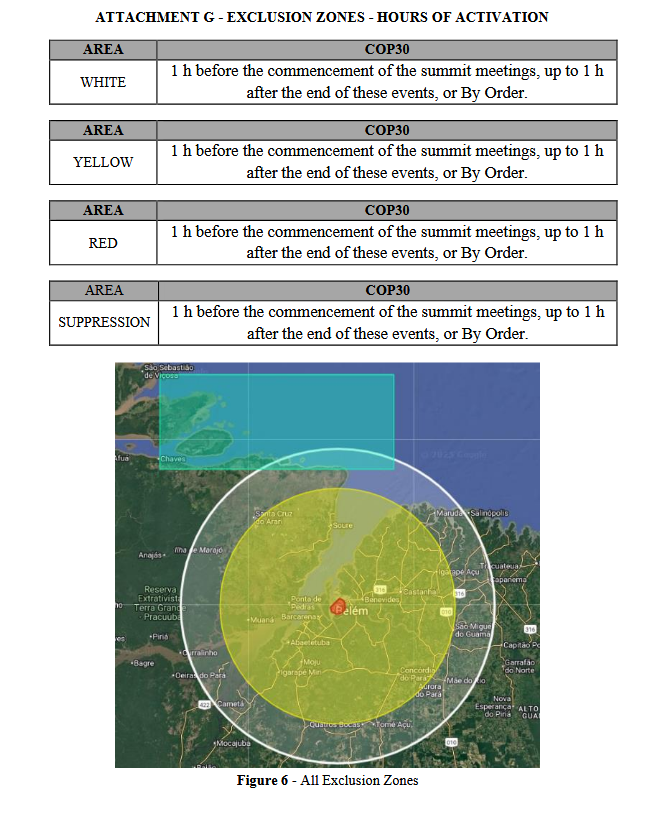
The lateral and vertical limits, the centers of the exclusion zones, with their respective radius lengths and the days and times of activation are described in Attachments of this publication.
Area named WHITE, beyond the limits of TMA-BE, in which specific rules for airspace use are applied, with the purpose of enabling ATC units to identify all air movements evolving within it, then raising the security level.
Area named YELLOW, located within the WHITE area in order to limit access to specific air movements that meet the criteria established by the Aerospace Defense Authority.
Area named RED, located within the YELLOW area in order to limit access only to aircraft involved in the event, with strict authorization from the Aerospace Defense Authority.
Area named SUPPRESSION, located within the RED area for the purpose of prohibiting air traffic.
NOTE: Only aircraft on a life-support mission may enter the Suppression Area, as authorized by the Aerospace Defense Authority.
NOTE: Only aircraft on a life-support mission may enter the Suppression Area, as authorized by the Aerospace Defense Authority.
5.1.1. In the WHITE AREA, including within the Special Use Airspaces (EAC), the following will be forbidden:
a) Training or instruction flights, whether using Instrument Flight Rules (IFR) or Visual Flight Rules (VFR);
b) Check flights and inspections;
c) Acrobatic, sightseeing, and glider flights;
d) Air experience flights and aircraft receipt; and
e) Operations of parachutes, paragliders, balloons, airship, ultralights, experimental aircraft, hang gliding, agricultural spraying, aerial advertising, model airplanes and rockets.
a) Training or instruction flights, whether using Instrument Flight Rules (IFR) or Visual Flight Rules (VFR);
b) Check flights and inspections;
c) Acrobatic, sightseeing, and glider flights;
d) Air experience flights and aircraft receipt; and
e) Operations of parachutes, paragliders, balloons, airship, ultralights, experimental aircraft, hang gliding, agricultural spraying, aerial advertising, model airplanes and rockets.
5.1.2. Aircraft crossing the Reserved Area (WHITE) in airways below FL 195, whose destination is not within the WHITE AREA, will be deviated. Aircraft crossing above FL 195 will not be deviated.
5.1.3. As long as the restrictions established for the YELLOW and RED AREAS, and the profile of the Approach Control (APP)/ Area Control Center (ACC) are exempted, the following is to be considered previously authorized:
a) Aircraft with origin in the WHITE AREA and destination outside it.
b) Aircraft with origin outside the WHITE AREA and destination within it; and
c) Aircraft with origin and destination within the WHITE AREA.
a) Aircraft with origin in the WHITE AREA and destination outside it.
b) Aircraft with origin outside the WHITE AREA and destination within it; and
c) Aircraft with origin and destination within the WHITE AREA.
5.1.4. All aircraft flying in the WHITE AREA must:
a) Have their Complete Flight Plan (PVC) submitted and approved by the ATC unit;
b) Maintain bilateral radiotelephone communications with the ATC unit;
c) Have transponder equipment in operation; and
d) Maintain the flight profile authorized by the ATC unit.
a) Have their Complete Flight Plan (PVC) submitted and approved by the ATC unit;
b) Maintain bilateral radiotelephone communications with the ATC unit;
c) Have transponder equipment in operation; and
d) Maintain the flight profile authorized by the ATC unit.
5.1.5. Take-off operations at locations without Air Traffic Services (ATS) shall be coordinated with the Belem Approach Control (APP-BE) by telephone +55 (92) 3652-5986. The flights within TMA-BE must be previously coordinated with APP-BE, by telephone +55 (92) 3652-5932. The activation of the A/C transponder code assigned by the ATC unit before take-off until the landing of the aircraft shall be mandatory. If there is a failure of the transponder equipment, the ATC unit must be immediately informed.
5.1.6. Helicopter operations are allowed for landing and take-off at local aerodromes, helipads, oil rigs and airspace transit, observing restrictions in RESTRICTED and PROHIBITED areas. Use of the established Special Helicopter Routes (REH) is mandatory, where applicable, and some may be temporarily suspended, as per specific legislation (AIC or NOTAM).
5.1.7. Aircraft, under ATC control and authorized to fly in the Reserved Area (WHITE), that modify their routes without ATC authorization and enter the Restricted Area (YELLOW), will be classified as SUSPICIOUS and will be subject to the MPEA.
5.1.8. Aircraft that enter the Restricted Area without authorization and cumulatively fly towards the Prohibited Areas will be classified as HOSTILE and subject to the MPEA.
5.2.1. The following aircraft will be allowed in the YELLOW AREA, provided that they have been previously submitted to the COMAE flight authorization process:
a) Aircraft carrying Heads of State, Heads of Government and Sovereigns;
b) Aircraft carrying: President of the Supreme Federal Court (STF), Speaker of the Chamber of Deputies, President of the Federal Senate, Minister of State, Governor of the State of Para and Mayor of the city of Belem;
c) Aircraft of the Brazilian Navy (MB), the Brazilian Army (EB) and the Brazilian Air Force (FAB), manned or unmanned, involved in operational actions of the event;
d) Aircraft ambulance in service;
e) Manned or unmanned aircraft of public security bodies in service;
f) Aircraft carrying VIPs, as classified by the Civil House of the Presidency of the Republic and the Ministry of Foreign Affairs (MRE);
g) Military aircraft performing arrival or departure procedures on air transport missions;
h) Aircraft involved in the event, as defined by the competent authority; and
i) Aircraft for transportation of valuables and mail.
a) Aircraft carrying Heads of State, Heads of Government and Sovereigns;
b) Aircraft carrying: President of the Supreme Federal Court (STF), Speaker of the Chamber of Deputies, President of the Federal Senate, Minister of State, Governor of the State of Para and Mayor of the city of Belem;
c) Aircraft of the Brazilian Navy (MB), the Brazilian Army (EB) and the Brazilian Air Force (FAB), manned or unmanned, involved in operational actions of the event;
d) Aircraft ambulance in service;
e) Manned or unmanned aircraft of public security bodies in service;
f) Aircraft carrying VIPs, as classified by the Civil House of the Presidency of the Republic and the Ministry of Foreign Affairs (MRE);
g) Military aircraft performing arrival or departure procedures on air transport missions;
h) Aircraft involved in the event, as defined by the competent authority; and
i) Aircraft for transportation of valuables and mail.
5.2.2. Only the following aircraft will be authorized to fly within the YELLOW AREA:
a) Aircraft of Class III, IV-A, IV-B, V and VI Air Operators, according to the Brazilian Civil Aviation Regulation (RBAC) no. 108, performing arrival or departure procedures from aerodromes in the TMA.
b) Aircraft of Class I, II-A and II-B Air Operators, provided that they comply with specific resolutions established by other Government Agencies and according to the National Civil Aviation Regulation (RBAC) no. 108:
a) Aircraft of Class III, IV-A, IV-B, V and VI Air Operators, according to the Brazilian Civil Aviation Regulation (RBAC) no. 108, performing arrival or departure procedures from aerodromes in the TMA.
b) Aircraft of Class I, II-A and II-B Air Operators, provided that they comply with specific resolutions established by other Government Agencies and according to the National Civil Aviation Regulation (RBAC) no. 108:
- The aircraft must depart from a public aerodrome with an Airport Security Program (PSA). The list containing approved airports with PSA may be obtained by clicking on the link: https://www.gov.br/anac/pt-br/assuntos/regulados/aeroportos-e-aerodromos/avsec/arquivos/dados_e_estatisticas_operadores
- Before boarding, all occupants of the aircraft (crew and passengers, if applicable) must be submitted to the Aerodrome Access Control by identification and registration, according to procedures defined by the responsible authority, among which the inspection by metal detector shall be compulsory;
- During boarding procedures, the occupants of the aircraft must not contact persons not inspected; if this occurs, a new inspection must be carried out;
- The baggage of persons who may not be on board must not be carried on the aircraft;
- All baggage shall be subject to inspection procedures established by the responsible authority;
- The transportation of cargo and mail, for Class II-B air operators, must comply with security measures related to identification, acceptance and inspection in accordance with criteria set out in specific civil aviation legislation;
- The aircraft must be positioned within the Restricted Security Area (ARS) of the aerodrome before boarding of crew and, if applicable, passengers;
- The aircraft must be subject to the following ground safety measures before take-off:
- Aircraft Security Inspection: it must be performed by the accredited service provider, contracted by the air operator, every time the aircraft enters the ARS of the aerodrome, when it is out of operation for a period exceeding 6 (six) hours or when there is a suspicion of improper access to the aircraft;
- Aircraft Security Check: it must be performed by the air operator prior to all flights for which an Aircraft Security Inspection is not conducted; and
- Access Control to the Aircraft: the accredited service provider, contracted by the air operator, must carry out constant surveillance of the aircraft, while in the ARS, with proper identification and registration of any person who approaches or accesses the aircraft for any purpose.
- The air operator must apply security measures related to in-flight supplies, if applicable, following procedures established in specific civil aviation legislation; and
- Aircraft originating from abroad, whose security procedures do not meet these criteria must land at an international airport in Brazilian territory before entering the YELLOW AREA, where the procedures will be performed.
5.2.3. All aircraft flying in the YELLOW AREA must:
a) Be expressly authorized by COMAE;
b) Have their Complete Flight Plan (PVC) submitted and approved by the ATC unit;
c) Maintain bilateral radiotelephone communications with the ATC unit;
d) Have transponder equipment in operation; and
e) Maintain the flight profile authorized by the ATC unit.
a) Be expressly authorized by COMAE;
b) Have their Complete Flight Plan (PVC) submitted and approved by the ATC unit;
c) Maintain bilateral radiotelephone communications with the ATC unit;
d) Have transponder equipment in operation; and
e) Maintain the flight profile authorized by the ATC unit.
5.2.4. Activities of the Security Forces and transport of VIP authorities will be prioritized by the ATC Units.
5.2.5. All aircraft that fail to comply with the rules established for the Restricted Area (YELLOW) or fly in non-compliance with the authorizations and instructions received from units dedicated to Air Traffic Control or Aerospace Defense will be classified as SUSPICIOUS and will be subject to the MPEA. If they cumulatively fly towards the Prohibited (RED) or Suppression Areas, they will be classified as HOSTILE and will be subject to the MPEA.
5.3.1. The following aircraft shall be allowed in the RED AREA, provided that they have been previously submitted to the COMAE flight authorization process:
a) Aircraft carrying Heads of State, Heads of Government and Sovereigns;
b) Aircraft carrying: President of the STF, President of the Chamber of Deputies, President of the Federal Senate, Minister of State, Governor of the State of Para and Mayor of the city of Belem;
c) Aircraft of the MB, the EB and the FAB, manned or unmanned, involved in operational actions of the event;
d) Aircraft ambulance in service, and search and rescue (SAR); and
e) Aircraft of public security bodies in service.
a) Aircraft carrying Heads of State, Heads of Government and Sovereigns;
b) Aircraft carrying: President of the STF, President of the Chamber of Deputies, President of the Federal Senate, Minister of State, Governor of the State of Para and Mayor of the city of Belem;
c) Aircraft of the MB, the EB and the FAB, manned or unmanned, involved in operational actions of the event;
d) Aircraft ambulance in service, and search and rescue (SAR); and
e) Aircraft of public security bodies in service.
5.3.2. All aircraft flying in the RED AREA must:
a) Be expressly authorized by COMAE;
b) Have their Complete Flight Plan (PVC) submitted and approved by the ATC unit;
c) Maintain bilateral radiotelephone communications with the ATC unit;
d) Have transponder equipment in operation; and
e) Maintain the flight profile authorized by the ATC unit.
a) Be expressly authorized by COMAE;
b) Have their Complete Flight Plan (PVC) submitted and approved by the ATC unit;
c) Maintain bilateral radiotelephone communications with the ATC unit;
d) Have transponder equipment in operation; and
e) Maintain the flight profile authorized by the ATC unit.
5.3.3. Aircraft of Class I, II-A and II-B (general aviation) Air Operators and those aircraft that fall under RBAC no. 121 (regular commercial aviation)
will not operate at any aerodrome within the Prohibited Area (RED), when this is activated.
5.3.4. Aircraft in service for immediate take-off due to contingency, emergency or urgency (alert or standby) situations shall not present PVC to the ATC unit, but must follow the following procedures:
a) Be submitted to the COMAE beforehand;
b) Meet with the appropriate ATC unit at least 01 (one) hour before the start of the alert or standby period;
c) Inform the COMAE Air Operations Cell through its representative in the CGNA Master Room or Local Cell in Belem about the launching of the mission, describing the profile of the flight to be carried out; and
d) Take off only after receiving authorization from COMAE and from the appropriate ATC unit.
a) Be submitted to the COMAE beforehand;
b) Meet with the appropriate ATC unit at least 01 (one) hour before the start of the alert or standby period;
c) Inform the COMAE Air Operations Cell through its representative in the CGNA Master Room or Local Cell in Belem about the launching of the mission, describing the profile of the flight to be carried out; and
d) Take off only after receiving authorization from COMAE and from the appropriate ATC unit.
5.3.5. Aircraft that enter the Prohibited Areas (RED) without authorization from COMAE will be classified as HOSTILE and will be subject to the MPEA.
5.4.1. Aircraft shall not be permitted to fly in the Suppression Area.
NOTE: Only aircraft on a life-support mission may enter the Suppression Area, with authorization from the Aerospace Defense Authority.
NOTE: Only aircraft on a life-support mission may enter the Suppression Area, with authorization from the Aerospace Defense Authority.
5.4.2. Pilots authorized to fly over the Prohibited Area (RED) must avoid the Suppression Area.
6.1. Aircraft intending to fly in the exclusion zones, during the period in which they are activated, must be listed in the updated repetitive flight plan (RPL) or present PVC at least 24 hours in advance via SIGMA/ FPL BR. DLA messages must also be submitted 24 hours prior to the new intended time. CHG messages will be considered if presented at least 24 hours in advance.
6.2. For aircraft with origin and/or destination within the WHITE AREA that present PVC that contains a flight segment under VFR flight rules, they must submit the plan at least 24 hours in advance. In this case, the AIS operators during the PVC treatment will include the APP-BE telegraphic address: SBBEZAZX.
6.3. The PVC must include the post-take-off alternate aerodrome(s), en route alternate aerodrome(s) and destination alternate aerodrome(s), as provided for in the legislation in force and, in the case of the RPL, these aerodromes must be reported to ATC units.
6.4. According to item 2.2.1 of ICA 100-40, public aerodromes in the role of coordinated aerodromes must not be used as an alternate aerodrome after take-off, route or destination, except for emergency situations or those authorized by the CGNA, during the period from 04 NOV 2025 to 22 NOV 2025.
6.5. The Command and Control Master Room, located at CGNA, shall be responsible for flight monitoring.
6.6. The Local Cell, located in Belem, shall be responsible for coordination with the Master Room at CGNA, the Main Military Air Operations Control Units, the Local Operation Cell, the ATS Units and the AIS Offices (ARO service).
6.7. The Command and Control Master Room, if necessary, may, even if all legal procedures for flight approval are fulfilled, interfere with the approval process, generating authorizations, suspensions or cancellations.
6.8. The CGNA reserves the right to reject flight intentions that do not meet the operational requirements of the event and those that may cause imbalance in the control sectors of any TMA or FIR, and even those that exceed the declared capacities of the airports involved.
7.1. The activation of exclusion zones will cause restrictions on landing and take-off operations at some aerodromes in respective areas, as described in the attachments related to exclusion zones. Only aircraft authorized by COMAE may operate at these aerodromes during the activation period.
7.2. The current instrument departure and arrival procedures shall not be suspended and/or cancelled, despite the restrictions imposed by the creation of these areas. The specific procedures for resolving traffic conflicts between CAG and the areas will be at the discretion of APP-BE.
8.1. The selection of airports was based on technical criteria. Not necessarily all selected airports will fulfill all the criteria, but they will have some broader set of capabilities to meet the demands of the event.
8.2. Annex H lists the civil and military aerodromes and their respective designations for the provision of alternate and overnight flight operations during the validity period of this AIC.
9.1. Due to special needs during the activation of areas, flight operations at this airport will be subject to the following restrictions:
a) RWY 03/21 will be closed to enable the security operation to be carried out by the Aerospace Defense;
b) Right turns are prohibited during operations, go-arounds, and takeoffs from RWY 07, as well as left turns from RWY 25, to prevent entry into the RED AREA;
c) Coordination of availability of parking spots, overnight or alternate aerodrome of Heads of State, dignitaries, delegations and private parties, in phases 1 and 2 of COP 30, in coordination with the company Líder Aviação;
d) Coordination with the company DNATA handling, ground support services and parking area is required regarding the special need for slope equipment, stay and other services on the ground;
e) All aircraft must have a tow bar on board;
f) Coordination of supply with the fuel and lubricant distributor is required;
g) Coordination of maximum time on the ground with the company Líder Aviação is required; and
h) RWY 07/25: Do not perform a return outside the turnaround area, EXC if authorized by the ATS unit, avoiding a turn over the aircraft axis.
a) RWY 03/21 will be closed to enable the security operation to be carried out by the Aerospace Defense;
b) Right turns are prohibited during operations, go-arounds, and takeoffs from RWY 07, as well as left turns from RWY 25, to prevent entry into the RED AREA;
c) Coordination of availability of parking spots, overnight or alternate aerodrome of Heads of State, dignitaries, delegations and private parties, in phases 1 and 2 of COP 30, in coordination with the company Líder Aviação;
d) Coordination with the company DNATA handling, ground support services and parking area is required regarding the special need for slope equipment, stay and other services on the ground;
e) All aircraft must have a tow bar on board;
f) Coordination of supply with the fuel and lubricant distributor is required;
g) Coordination of maximum time on the ground with the company Líder Aviação is required; and
h) RWY 07/25: Do not perform a return outside the turnaround area, EXC if authorized by the ATS unit, avoiding a turn over the aircraft axis.
10.1. The SAC, through the ANAC, in coordination with the Airport Administrators, will establish the maximum times on the ground at the aerodromes involved in the event, in order to guarantee the flow of air operations in the installed infrastructures.
10.2. The stay at Belém airport must be requested to the company Líder Aviação, responsible for coordinating the positioning, time of stay and parking of the aircraft of Heads of State, dignitaries, delegations and private parties during this period.
10.3. The Air Bases will establish the maximum ground time of the aircraft that will be served in their aprons.
10.4. Operators of aircraft who fail to comply with the established times will be subject to sanctions provided by law.
10.5. The times on the ground, as well as all information concerning the coordination with aerodromes involved, for example, coordination period, time slot, ATS clearances, aerodromes that can be used as an alternate, among others, will be published through Notice to Airmen (NOTAM) specific for each aerodrome involved.
The transponder is the primary means of identification for traffic evolving in airspace during air operations. Thus, only flights of aircraft that have the equipment on board and in operation shall be authorized. Flights of aircraft without transponder shall not be allowed in the exclusion zones, in any case.
12.1. Special Aircraft Routes (REA) and Special Helicopter Routes (REH) that cross the RED areas will have these segments suspended during the activation period.
12.2. Flights in the REA and REH will be allowed within the WHITE area, provided that the rules established for the circulation in this area are respected.
12.3. Visual flights within the YELLOW area will only be allowed through the REA and REH. If the movement within these routes is interrupted due to the suspension of some segment or gate, APP-BE will direct traffic in order to avoid the areas.
13.1. Users must, in addition to observing the rules and procedures provided for in legislation, comply with the flight rules foreseen in the authorized PVC. If there is a need to modify the flight rules, requests must be coordinated with ATC units.
13.2. Aircraft that do not comply with the intended flight profile or flight rule, without the authorization of ATC units and/or enter any of the exclusion zones without permission, will be subjected to the Airspace Policing Measures (MPEA) and be compelled to leave restricted airspace and/or make landings at aerodromes intended for the application of Ground Control Measures (MCS).
13.3. If the pilot is authorized to use the exclusion zones, in case there is any need to deviate from the approved route, it is mandatory that the pilot immediately notifies the ATC unit.
13.4. The pilot who believes that (s)he will violate any of the rules established for RESERVED, RESTRICTED or PROHIBITED airspace without proper authorization from the ATC unit must immediately move away from them, contact the ATC unit and report the situation, keeping the transponder code originally received. However, if the pilot does not get any contact over radio,
(s)he must call on frequency 121.5 MHz and squawk code 7600. ATC units will provide full support to pilots.
(s)he must call on frequency 121.5 MHz and squawk code 7600. ATC units will provide full support to pilots.
13.5. In no event shall any aircraft enter the RED AREA without being authorized by the ATC unit.
Upon detecting a failure in the on-board radio equipment during the authorization and taxi phases, the pilot whose flight plan includes entrance in the exclusion zone must not proceed with the flight and must remain in her/his parking position or return to it.
An aircraft that is in a take-off radio communications failure, performing a standard instrument departure (SID) or en route procedure and whose destination aerodrome is within the exclusion zone must:
a) Stay outside the lateral and/or vertical limits of the WHITE AREA;
b) Proceed to the post-take-off alternate aerodrome, en route aerodrome or destination alternate aerodrome, provided that these are not within an exclusion zone; and
c) Squawk the transponder code 7600 and perform the other procedures for radio communications failure provided for in legislation.
a) Stay outside the lateral and/or vertical limits of the WHITE AREA;
b) Proceed to the post-take-off alternate aerodrome, en route aerodrome or destination alternate aerodrome, provided that these are not within an exclusion zone; and
c) Squawk the transponder code 7600 and perform the other procedures for radio communications failure provided for in legislation.
An aircraft that is experiencing a radio communications failure during take-off or performing a SID shall continue climbing and meet all the following conditions:
a) Strictly comply with the provisions of the SID being executed;
b) Proceed to the destination aerodrome, post-take-off alternate aerodrome, en route aerodrome or destination alternate aerodrome, provided that they are not within an exclusion zone; and,
c) Squawk the transponder code 7600 and perform the other procedures for radio communications failure provided for in legislation.
a) Strictly comply with the provisions of the SID being executed;
b) Proceed to the destination aerodrome, post-take-off alternate aerodrome, en route aerodrome or destination alternate aerodrome, provided that they are not within an exclusion zone; and,
c) Squawk the transponder code 7600 and perform the other procedures for radio communications failure provided for in legislation.
a) Strictly comply with the provisions of the SID being executed;
b) Proceed to the destination aerodrome, squawk the transponder code 7600 and perform the other procedures for radio communications failure provided for in legislation;
c) Strictly comply with the instrument approach procedure being performed; and
NOTE: The aircraft may proceed to alternate aerodrome or other unplanned aerodrome only in case of emergency, and must squawk the transponder code 7700.
b) Proceed to the destination aerodrome, squawk the transponder code 7600 and perform the other procedures for radio communications failure provided for in legislation;
c) Strictly comply with the instrument approach procedure being performed; and
NOTE: The aircraft may proceed to alternate aerodrome or other unplanned aerodrome only in case of emergency, and must squawk the transponder code 7700.
An aircraft that is in a radio communications failure while performing a SID, beyond the lateral and/or vertical limits of the WHITE AREA, or in level flight must:
a) Remain outside the WHITE AREA limits; and
b) Squawk the transponder code 7600 and perform the other procedures for radio communications failure provided for in legislation.
a) Remain outside the WHITE AREA limits; and
b) Squawk the transponder code 7600 and perform the other procedures for radio communications failure provided for in legislation.
An aircraft that is in radio communications failure and has already begun the descent phase of the flight or is performing an instrument arrival, before entering the lateral and/or vertical limits of the WHITE AREA, must:
a) Proceed to the destination alternate aerodrome, which must be outside the WHITE AREA;
b) Squawk the transponder code 7600 and perform the other radio communications failure procedures provided for in legislation; and
c) Remain outside the WHITE AREA limits; and
a) Proceed to the destination alternate aerodrome, which must be outside the WHITE AREA;
b) Squawk the transponder code 7600 and perform the other radio communications failure procedures provided for in legislation; and
c) Remain outside the WHITE AREA limits; and
An aircraft that is in a radio communications failure WITHIN THE WHITE and/or YELLOW AREA and has already begun an instrument approach procedure may proceed to approach provided that it meets all of the following conditions:
a) Strictly comply with the instrument approach procedure being performed; and
b) Squawk the transponder code 7600 and perform the other procedures for radio communications failure provided for in legislation.
a) Strictly comply with the instrument approach procedure being performed; and
b) Squawk the transponder code 7600 and perform the other procedures for radio communications failure provided for in legislation.
14.8.1. AIRCRAFT IN COMMUNICATIONS FAILURE and UNIDENTIFIED will be subject to the MPEA and, if necessary, may undergo severe measures, being subject to the INTERVENTION, PERSUASION and DESTRUCTION MEASURES.
14.8.2. An aircraft being INTERCEPTED must immediately follow the instructions given by the intercepting aircraft at 121.5 MHz and/or interpret and respond to visual signals. If equipped with transponder equipment, select code 7700, in mode 3/A, unless otherwise instructed by the appropriate ATC unit.
14.8.3. The COMAER reserves the right to intercept any aircraft, at the discretion of the air defense bodies or the authorities responsible for the execution of aerospace defense missions.
15.1. Flights within the RESERVED area (WHITE) will be allowed, in compliance with the rules and procedures provided for in legislation. The flight permit may be revoked at any time upon request from the Aerospace Defense Authority.
15.2. The Flight Restriction Zone (FRZ) of the RESTRICTED area (YELLOW) will be created by the Fourth Integrated Center for Air Defense and Air Traffic Control (CINDACTA IV), through the Unmanned Aircraft Airspace Access Request System (SARPAS) of DECEA.
15.3. The Flight Restriction Zone (FRZ) of the PROHIBITED area (RED) will be created by the CINDACTA IV, through the DECEA SARPAS.
15.4. Within the PROHIBITED area (RED) only flights approved by COMAE will be allowed.
15.5. Additionally, No-Fly Zones (NFZ) will be created in sensitive areas defined by the Federal Police, through technical blocking to be required from manufacturers.
15.6. Aircraft that enter FRZ or NFZ without authorization will be classified as HOSTILE and will be subject to MPEA, as well as the containment by C-UAS system of Public Security Agencies and Brazilian Armed Forces.
a) Receipt of the list of approved aircraft, by area, by DECEA: 10 OCT 2025;
b) Request for the creation of NFZ with approved aircraft listing: 17 OCT 2025; and
c) Creation of FRZ by CINDACTA IV and beginning of the registration of authorized aircraft: 17 OCT 2025.
a) Receipt of the list of approved aircraft, by area, by DECEA: 10 OCT 2025;
b) Request for the creation of NFZ with approved aircraft listing: 17 OCT 2025; and
c) Creation of FRZ by CINDACTA IV and beginning of the registration of authorized aircraft: 17 OCT 2025.
15.7. As responsible for the control of Brazilian airspace, COMAER will be in charge of requesting the NFZ to manufacturers of unmanned aircraft registered with ANAC to operate in Brazil.
15.8. Foreign drones must comply with the rules in force of the National Telecommunications Agency (ANATEL), the National Civil Aviation Agency (ANAC) and finally the DECEA.
15.9. More information on the operation of unmanned aircraft in exclusion zones may be obtained through the UA Drone portal, available at:
https://www.decea.mil.br/drone/
NOTE: Regardless of the altitude, type of flight and weight of the aircraft, they can only fly within the FRZs created by DECEA, aircraft with registration in the System of Unmanned Aircraft (SISANT) of the National Civil Aviation Agency (ANAC) and flight authorization issued in the SARPAS system of DECEA.
NOTE: Regardless of the altitude, type of flight and weight of the aircraft, they can only fly within the FRZs created by DECEA, aircraft with registration in the System of Unmanned Aircraft (SISANT) of the National Civil Aviation Agency (ANAC) and flight authorization issued in the SARPAS system of DECEA.
16.1. This AIC comes into force on 03NOV2025 revoking AIC A 24/25.
16.2. The unplanned cases will be resolved by the Head of the DECEA Operations Subdepartment.